
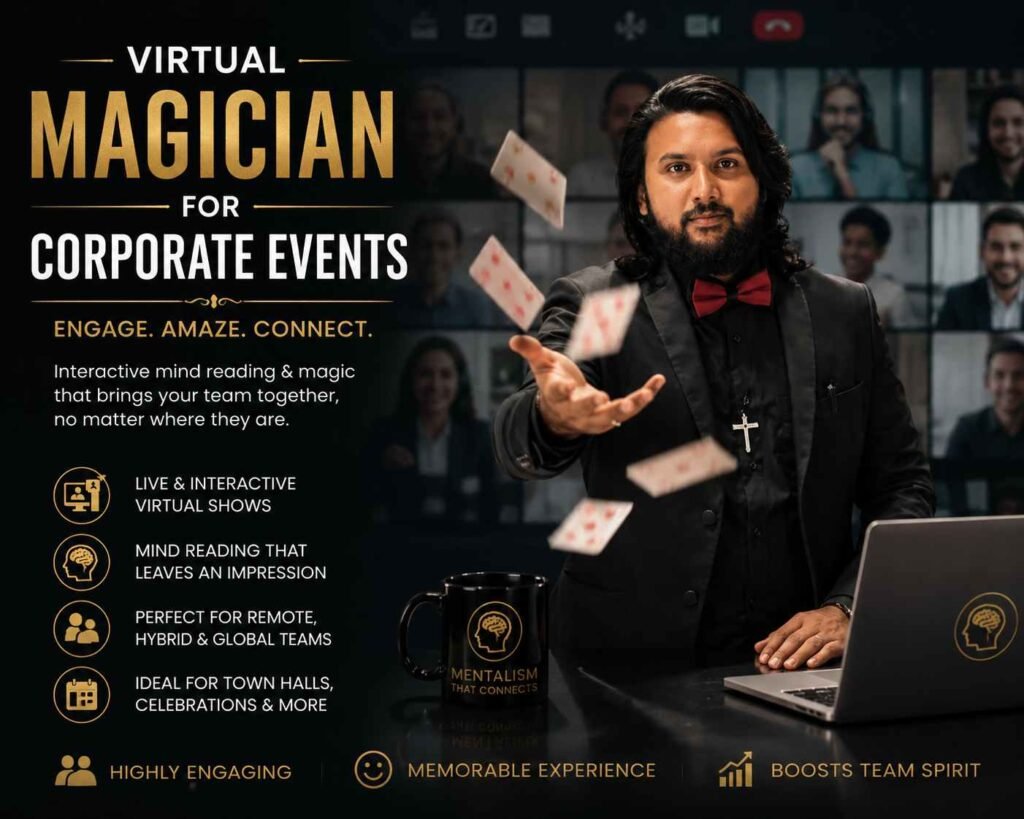
Remote and hybrid work did not remove the need for real engagement moments, it just changed where the audience is sitting. HR teams still need entertainment for town halls, quarterly celebrations, and distributed team events, but the venue is now a video call rather than a conference room. A virtual magician for a corporate event solves exactly this gap, bringing genuine, interactive magic and mentalism to a screen rather than a stage.
I have performed for remote and hybrid corporate audiences across the same repertoire I use in person, proving that mentalism and mind-reading translate through a camera just as effectively as they do live. This guide covers what to expect from a virtual show and how to plan one that actually lands with a distributed team.
Why Virtual Entertainment Needs a Different Approach
A show built for a physical room does not automatically work on a screen. Grand illusion, for example, relies on scale and physical presence that a webcam simply cannot capture the same way. Mentalism, on the other hand, translates unusually well to video, since the core of the format is psychological interaction, reading a thought, predicting a decision, which works just as powerfully through a screen as it does across a room.
This is why a genuinely good virtual magician show is not simply a stage act performed in front of a laptop camera. It needs to be built specifically for the format, accounting for how attention, interaction, and pacing all work differently when your audience is scattered across dozens of individual screens instead of sitting together in one room.
What a Virtual Magic Show for Corporate Events Actually Looks Like
A typical virtual corporate show runs through a video conferencing platform, with the performance built around mentalism and mind-reading segments that pull in remote participants directly, having someone type a word into chat, hold up an object to their own camera, or think of a number that gets correctly revealed. This direct interaction is what keeps a remote audience engaged rather than passively watching a stream.
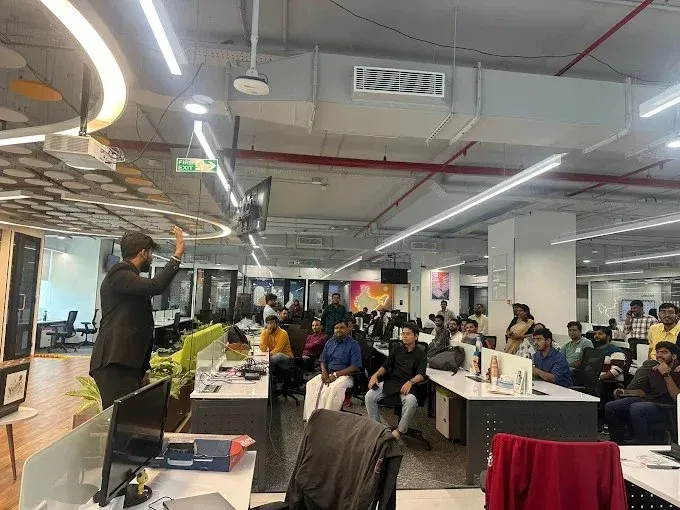
The format works especially well for hybrid events too, where part of the audience sits in a physical room and part joins remotely. A well-built virtual segment can involve both groups in the same trick simultaneously, closing the gap between in-office and remote employees that many hybrid events struggle to bridge.
Where Virtual Magic Fits on a Corporate Calendar
Here are the situations where a virtual show makes the most sense.
- Fully Remote Team Town Halls
For companies with a fully distributed team, a virtual mentalism segment built into a quarterly town hall gives remote employees the same kind of shared, memorable moment an in-office team gets from a live show, without anyone needing to travel.
- Hybrid Events With a Split Audience
When part of your team is in the office and part is remote, a virtual show designed to involve both groups avoids the common hybrid-event problem where remote employees feel like they are watching someone else’s party through a screen.
- Multi-City or Multi-Country Celebrations
Companies with offices spread across cities or countries can use one virtual show to deliver the same experience everywhere simultaneously, rather than trying to coordinate separate in-person bookings at every location.
- Client-Facing Virtual Events
Virtual mentalism also works well for client webinars or virtual product launches that want a memorable, interactive moment rather than a standard presentation format, giving the event something genuinely different from a typical video call.
- Onboarding and New-Hire Welcome Sessions
A short virtual mentalism segment built into a remote onboarding session gives new hires an early, positive, memorable moment with the company, something most onboarding processes, focused entirely on paperwork and system access, rarely provide.
A Quick Checklist Before Your Virtual Event
Confirm the platform and meeting link well ahead of time, test audio and video quality beforehand rather than assuming it will work smoothly on the day, brief your team that the session will be interactive, and keep the segment to 20 to 30 minutes to match realistic video-call attention spans.
These small checks take little effort but consistently separate a virtual show that genuinely lands from one that feels like just another video call with slightly unusual content.
The Future of Virtual Corporate Entertainment
As hybrid work continues to shape how companies operate, virtual entertainment has moved from a pandemic-era substitute to a genuine, permanent category of corporate event format in its own right. Companies increasingly plan virtual and hybrid events deliberately, rather than treating them as a fallback for when in-person gatherings are not possible.
This shift means virtual show quality has become genuinely important to invest in properly, rather than treated as a lesser version of in-person entertainment. A well-produced virtual mentalism segment, with strong audio, thoughtful interaction design, and confident on-camera presence, now stands on its own as a legitimate, memorable corporate event format rather than a compromise.
The Technical Setup Behind a Genuinely Good Virtual Show
A professional virtual show involves more than simply switching on a webcam. Reliable, high-quality audio matters more than video quality for mentalism specifically, since the audience needs to hear predictions, questions, and reveals clearly without any distracting lag or dropout, which can break the sense of a live, unfolding moment that the format depends on entirely.
Camera framing and lighting also matter more than most planners initially expect. A poorly lit, awkwardly framed shot undercuts the professional standard corporate audiences expect, even if the actual mentalism content is strong. A genuinely prepared virtual performer treats their setup with the same seriousness a broadcast professional would, dedicated lighting, a stable camera position, and a clean, uncluttered background, rather than an improvised laptop-camera setup thrown together minutes before the call.
Screen sharing and interactive tools also play a role in many virtual formats, using chat functions, polls, or shared screens to bring remote participants into the performance directly rather than leaving them purely as passive viewers. Confirming these technical details ahead of time, rather than assuming they will work smoothly on the day, is one of the most overlooked steps in planning a successful virtual corporate event.
How to Prepare Your Team for a Virtual Show
A little preparation meaningfully improves how a virtual show lands. Send the meeting link and any joining instructions well ahead of time, and ask attendees to join with cameras on where possible, since visible reactions and participation from the audience are part of what makes the interaction feel genuinely live rather than pre-recorded.
If the session involves specific interaction, holding up an object, typing into chat, briefing your team even loosely beforehand, letting them know the session will be interactive rather than a passive presentation, tends to improve participation significantly. People engage more readily with something they know is coming than with an unexpected format shift mid-meeting.
Virtual Versus In-Person: Choosing the Right Format
Not every event needs to be virtual just because part of the team is remote. If the majority of your audience is in one physical location, an in-person show with a virtual streaming option for remote attendees often works better than a fully virtual format, since the in-room energy still anchors the experience for most of the audience.
A fully virtual show makes the most sense when your audience is genuinely distributed, no single location holds a majority of attendees, or when travel and venue costs make an in-person event impractical for the specific occasion. Being honest about which category your event falls
Common Mistakes With Virtual Corporate Entertainment
Booking a performer who has only ever done in-person shows. A stage-first performer without genuine virtual experience often struggles with pacing and camera-specific interaction, which flattens the show significantly compared to a format built for video from the start.
Ignoring the technical setup. Audio quality and connection stability matter more in a virtual show than almost any other factor, since a laggy stream breaks the illusion of real-time interaction that mentalism depends on entirely.
Making the session too long. Video-call attention spans are shorter than in-room attention spans. A virtual segment of 20 to 30 minutes usually lands better than trying to stretch a full-length stage show format onto a screen.

Booking a Virtual Show
I bring the same standard to virtual shows that I bring to every in-person corporate booking: real audience interaction, clean corporate-safe comedy, and a format built specifically for your event rather than a generic stream. Whether your team is fully remote, hybrid, or spread across multiple cities, I can build the show around your specific setup.
Reach out at +91 8971108123 or contact@illusionisttyson.com with your platform, expected headcount, and event date, and I will confirm the right virtual format for your team.
You can also follow our Magician on Instagram to watch amazing magic show videos, audience reactions, and live event highlights.
For corporate collaborations and professional updates, you can connect with our magician on LinkedIn and stay updated with upcoming events and performances.
Frequently Asked Questions
1. What platforms do virtual magic shows work on?
Virtual shows can run on standard video conferencing platforms like Zoom, Google Meet, or Microsoft Teams, whichever your company already uses for team calls.
2. How much does a virtual magician cost for a corporate event?
Pricing depends on show length and audience size. Message +91 8971108123 with your details and I will send a clear quote.
3. Can a virtual show involve everyone on a large call, or only a few people?
Interactive segments typically pull in several participants directly through chat or camera, while the mentalism format is built so the wider audience feels engaged even when only a few people are actively participating at any moment.
4. Is a virtual magic show suitable for a hybrid event near me?
Yes, hybrid formats can involve both an in-room audience and remote participants in the same segment, which is one of the most requested formats for companies with a mixed office and remote team.
5. How long does a virtual corporate magic segment usually run?
Most virtual segments run 20 to 30 minutes, shorter than a typical in-person show, since video-call attention spans work differently than in-room attention.
Book This Show
Illusionist Tyson | 23rd Cross Rd, Sir M V Nagar, Ramamurthy Nagar, Bengaluru, Karnataka 560016
Call: +91 8971108123 | Email: contact@illusionisttyson.com | Web: illusionisttyson.com.