
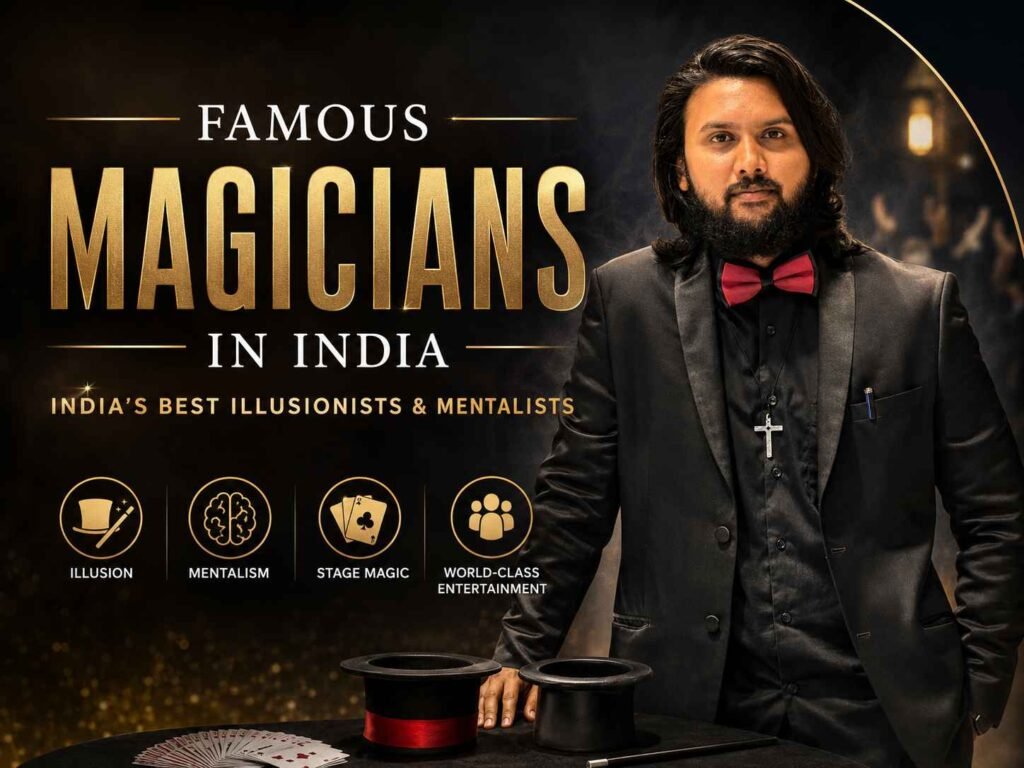
India has one of the richest magic traditions in the world, long before the term illusionist entered corporate event briefs. From street performers running the classic Indian rope trick to modern stage mentalists performing at award ceremonies and product launches, the country’s relationship with magic has evolved dramatically while never losing its core appeal: the willingness to be genuinely surprised.
As someone who has spent over a decade performing on India’s corporate stages, I get asked often who counts among the country’s best magicians, and where that tradition stands today. This guide walks through both the legends who built India’s magic reputation and how the craft has adapted for the modern corporate audience.
The Legends Who Built India's Magic Tradition
No conversation about famous magicians in India starts anywhere but with P.C. Sorcar. P.C. Sorcar Sr. became internationally known through the mid-20th century for grand stage illusions, and his television performances introduced generations of Indians to large-scale magic as genuine spectacle rather than street entertainment. His son, P.C. Sorcar Jr., carried the family’s stage tradition forward, continuing to perform large illusion shows for decades and becoming a household name in his own right.
Beyond the Sorcar family, India’s magic tradition runs deep in street and folk performance, the classic rope trick, cup-and-ball routines, and improvised close-up magic performed for centuries in marketplaces and festivals long before formal stage shows existed. This street tradition is genuinely part of what makes Indian audiences some of the most engaged magic audiences in the world; there is a cultural memory of magic as something communal and interactive, not just something watched from a distance.
How Indian Magic Has Shifted Toward Corporate and Mentalism Formats
Over the last two decades, the biggest shift in Indian magic has been the rise of corporate and mentalism-focused performance. Where the Sorcar-era tradition centred on grand stage illusion for public audiences, today’s most in-demand performers increasingly work corporate stages, award ceremonies, product launches, and executive events, where the format leans more toward psychological mentalism and audience interaction than pure spectacle.
This shift reflects what corporate audiences actually respond to. A room full of analytical, skeptical professionals, the exact profile you find across Bengaluru’s tech and consulting firms, engages far more with a mentalist reading a genuine thought or predicting a real decision than with a purely visual illusion performed at a distance. The best performers working India’s corporate circuit today have built their reputation specifically around this interactive, psychology-driven style.
Where Bengaluru's Corporate Magic Scene Stands Today
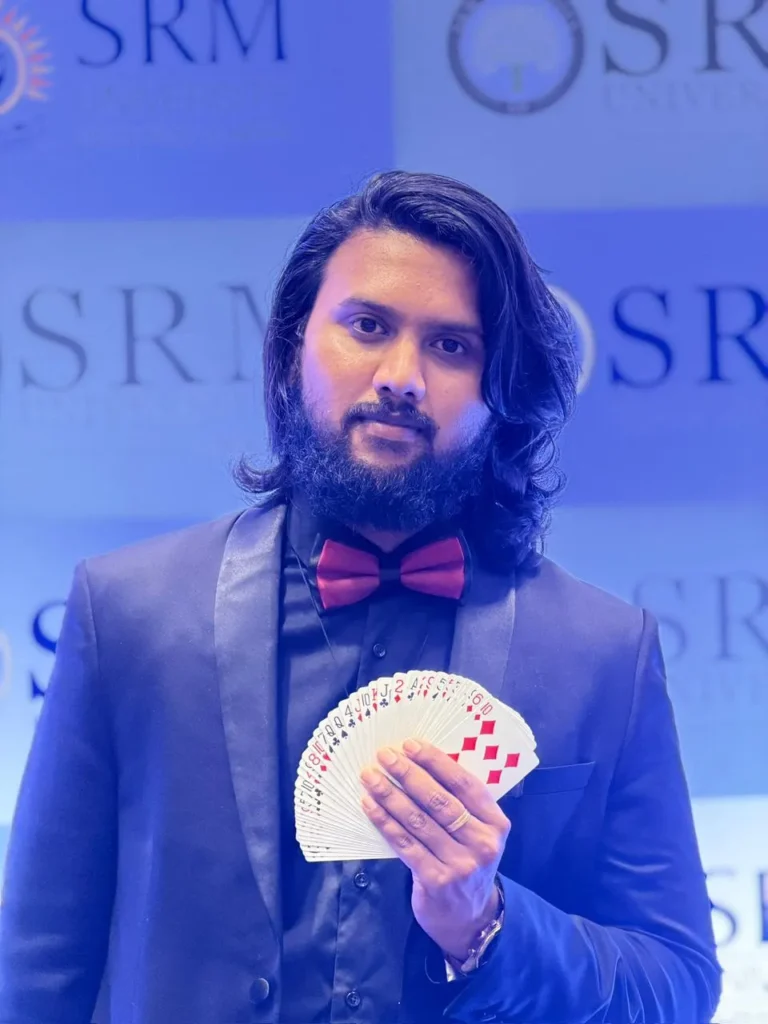
Bengaluru, as India’s technology capital, has become one of the country’s most active markets for corporate magic and mentalism. Companies here, from global names like Google, Microsoft, and EY to fast-growing firms like ThoughtSpot and SIMA.AI, regularly book entertainment for annual days, leadership events, and employee engagement calendars, and the audience’s analytical nature has pushed performers toward sharper, more genuinely surprising material rather than relying on scale alone.
I have built my own career inside this specific scene, performing over 2,000 shows across corporate events, private gatherings, and charity performances over more than a decade. My work spans stage magic and mentalism, close-up and walkaround magic, grand illusion, and my signature flagship show, Beyond Impossible, which weaves illusion, mentalism, and interaction together, built specifically for the kind of audience Bengaluru’s corporate calendar attracts.
How This History Shapes My Own Approach
Building a career inside this tradition means carrying both threads forward, the visual spectacle rooted in India’s stage magic history, and the intimate, interactive style rooted in its street and folk tradition. My shows deliberately blend both, opening with visual magic and closing with mentalism, giving a corporate audience the full range of what Indian magic has always offered rather than a narrow slice of just one style.
This blended approach is also why the format works so consistently across such different settings, corporate stages, private celebrations, and charity events, since it draws on a tradition that has always adapted to whoever is in the room, whether that room is a marketplace crowd centuries ago or a Bengaluru boardroom today.
What This Means for Anyone Booking a Magician Today
For a planner or private host trying to navigate this landscape, the practical takeaway is simple. India’s magic tradition is genuinely rich and varied, but the specific style you need depends entirely on your event. A public spectacle tradition rooted in the Sorcar legacy suits a very different occasion than the intimate, psychology-driven mentalism format that dominates today’s corporate and private booking scene.
Understanding this history is not just trivia, it actually helps set realistic expectations. A performer drawing on the modern corporate mentalism tradition will offer a genuinely different experience than one built around large-scale stage illusion, and knowing which tradition fits your event helps you ask better questions and set clearer expectations before booking anyone.
The Global Context: How Indian Magic Compares
India’s magic tradition sits within a much larger global history of the craft, and understanding that context helps explain why the Indian style, particularly its emphasis on audience interaction and communal experience, has translated so effectively into today’s corporate format. Western magic traditions, particularly the large-scale Las Vegas style popularised through the 20th century, leaned heavily toward spectacle and technical illusion at scale, grand disappearances, elaborate stage mechanics, built primarily for paying theatre audiences.
India’s street and folk tradition, by contrast, developed in far more intimate, communal settings, marketplaces, festivals, and family gatherings, where the performer and audience were often standing within arm’s reach of each other. This closeness shaped an Indian magic sensibility that has always valued direct interaction over pure scale, which is precisely the quality that makes mentalism and close-up formats resonate so strongly with Indian corporate audiences today. The corporate mentalism boom in cities like Bangalore is, in a real sense, a return to this older, more intimate Indian tradition, just wearing a modern professional format.
How the Craft Has Changed From Public Spectacle to Private Booking
The Sorcar era built its reputation through public performance, ticketed shows, television specials, and large audiences gathered specifically to watch magic as the main event. Today’s most active corporate performers build their reputation almost entirely through private, invitation-only bookings, corporate offices, weddings, executive retreats, where the audience did not come specifically for a magic show but discovers the entertainment as part of a larger event.
This shift changes what skill actually matters most. Public spectacle rewards scale and visual grandeur, since a paying audience expects a big show. Private corporate bookings reward relevance and fit, reading a specific room, tailoring content to a specific company or occasion, and working within a format the client has chosen rather than one the performer sets entirely on their own terms. Both are legitimate skills, but they are genuinely different disciplines.
What to Look for When Comparing 'Famous' or Highly Rated Performers
Public fame and corporate reliability do not always overlap. A performer well known for public shows or television appearances is not automatically the strongest choice for a corporate event, since the skills that build public fame, showmanship at scale, are not identical to the skills that make a corporate booking succeed, audience-appropriate content, punctuality, and adaptability to a company’s specific goals.
When evaluating who counts as a leading performer for your specific event, weight verifiable, relevant experience more heavily than general reputation. A performer with a strong, specific track record across companies similar to yours is usually a safer choice than one whose fame comes primarily from an unrelated format.
What Makes a Magician 'Famous' in the Corporate Context
Fame in magic used to mean television specials and large public stage shows, the Sorcar model. In the corporate world, reputation is built differently. It comes from repeat bookings, client trust, and the kind of word-of-mouth that moves between HR teams and event planners across companies. A magician’s standing in this circuit is measured less by public recognition and more by whether the same companies keep calling for the next event.
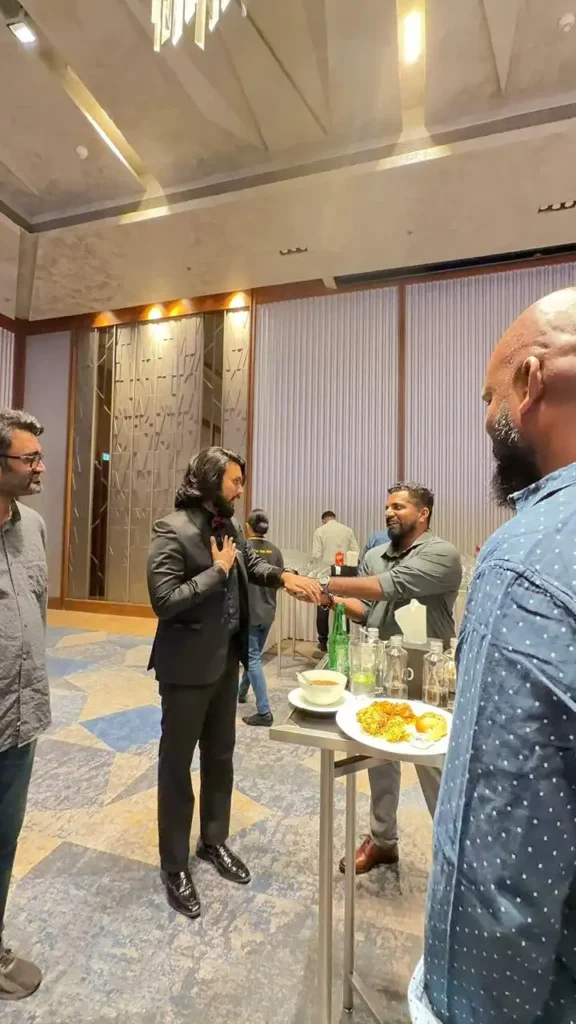
Over the years, I have had the privilege of performing repeatedly for corporate giants like EY, Microsoft, and Google, alongside coverage in outlets like the Times of India, ANI News, and The Print, and my work has included over 500 dedicated charity shows bringing magic to underprivileged communities across India. This combination, corporate trust plus a genuine charitable mission, is increasingly what defines a well-regarded name on India’s current magic circuit.
You can also follow our Magician on Instagram to watch amazing magic show videos, audience reactions, and live event highlights.
For corporate collaborations and professional updates, you can connect with our magician on LinkedIn and stay updated with upcoming events and performances.
Frequently Asked Questions
1. Who is the most famous magician in India historically?
P.C. Sorcar Sr. is widely regarded as India’s most famous magician historically, known for grand stage illusions and international performances through the mid-20th century, with his son P.C. Sorcar Jr. continuing the family’s stage tradition.
2. Who are the best magicians for corporate events in India today?
The corporate circuit today favours performers built specifically around mentalism and audience interaction rather than pure stage illusion. I have built my own reputation in this space performing for companies like EY, Microsoft, and Google across Bengaluru.
3. What is the difference between a traditional magician and a corporate mentalist?
A traditional stage magician, in the Sorcar tradition, focuses on visual illusion and large-scale spectacle. A corporate mentalist focuses on psychological interaction, predicting thoughts and decisions, which tends to resonate more strongly with professional, analytical corporate audiences.
4. Is Indian street magic, like the rope trick, still performed today?
Traditional street magic still exists in parts of India, though it has become less common than it was decades ago. Its cultural legacy lives on in how interactive and communal Indian magic audiences remain compared to many other countries.
5. How do I find a good magician for a corporate event near me?
Look for a performer with a specific track record of corporate bookings, not just public or wedding events, since corporate audiences respond to a different style than a general public show. Reach out directly at +91 8971108123 to discuss your event.
Book This Show
Illusionist Tyson | 23rd Cross Rd, Sir M V Nagar, Ramamurthy Nagar, Bengaluru, Karnataka 560016
Call: +91 8971108123 | Email: contact@illusionisttyson.com | Web: illusionisttyson.com